

What are tickers and indices? On PolitiCap, a ticker is a virtual listing — usually a real officeholder or a special political-capital figure — with a quote board in DutchB / dibs. An index (composite) is a parent shell that groups related tickers so the market stays navigable: countries, parties, councils, and a dedicated technologists basket.
Try a few: TRUMPD · XIJINP · MUSKE · TECH · USA · WORLD
Not real securities. Not a brokerage. Not cash-out gambling.
Closed-loop virtual credits on a civic market simulation — the math keeps the board honest inside the game.
Tickers (the leaves)
Each live person listing has a short symbol (3–8 letters, e.g. VANCEJD), a display name, optional office title, and a session quote. Defaults at IPO (house rule):
- Outstanding shares N = 1 000 000
- Open Popen = 10.00 DutchB (heads of government / typical first print)
- Delisted = N (live)
Hover any OCASIA-style badge on this site for the live popup, or open the full board at /t/SYMBOL/.
The tape math
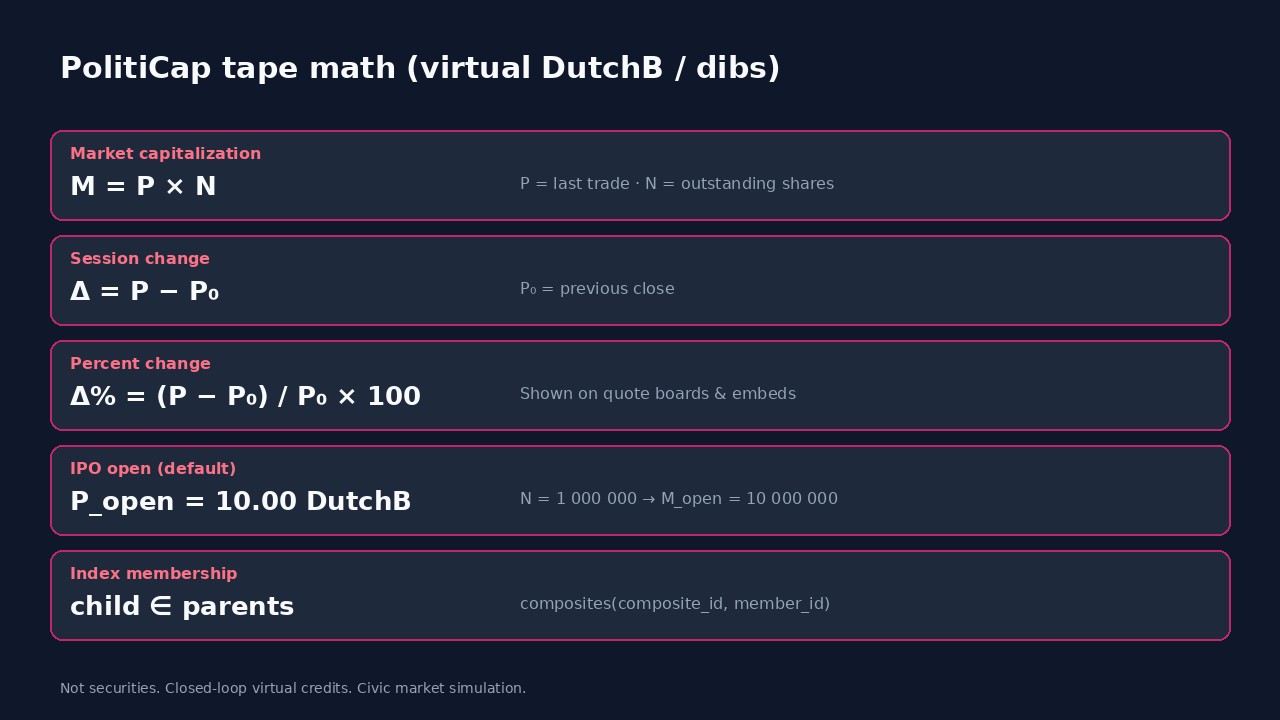
For a single ticker at last price P with previous close P₀ and outstanding shares N:
| Quantity | Formula | Example (TRUMPD-style IPO) |
|---|---|---|
| Market capitalization | M = P × N | 10.00 × 1 000 000 = 10 000 000 DutchB |
| Session change | Δ = P − P₀ | If P = 10.50 and P₀ = 10.00 → Δ = +0.50 |
| Percent change | Δ% = (P − P₀) / P₀ × 100 | +0.50 / 10.00 × 100 = +5.0% |
| Session range | day_min ≤ P ≤ day_max | Tracks prints inside the trading day |
Volume is the count of shares printed in the session (virtual inventory flips, MarketMaker noise, player orders). It does not create real-world cash flow.
Worked example — technologist listing. Suppose MUSKE last-traded at 5.00 DutchB with N = 1 000 000:
MMUSKE = 5.00 × 1 000 000 = 5 000 000 DutchB
If the previous close was also 5.00, then Δ = 0 and Δ% = 0 — a flat tape until the next print.
Indices (the shells)
An index on PolitiCap is a ticker with composite = 1. Membership is stored in the composites table: each row is a directed edge parent → child.
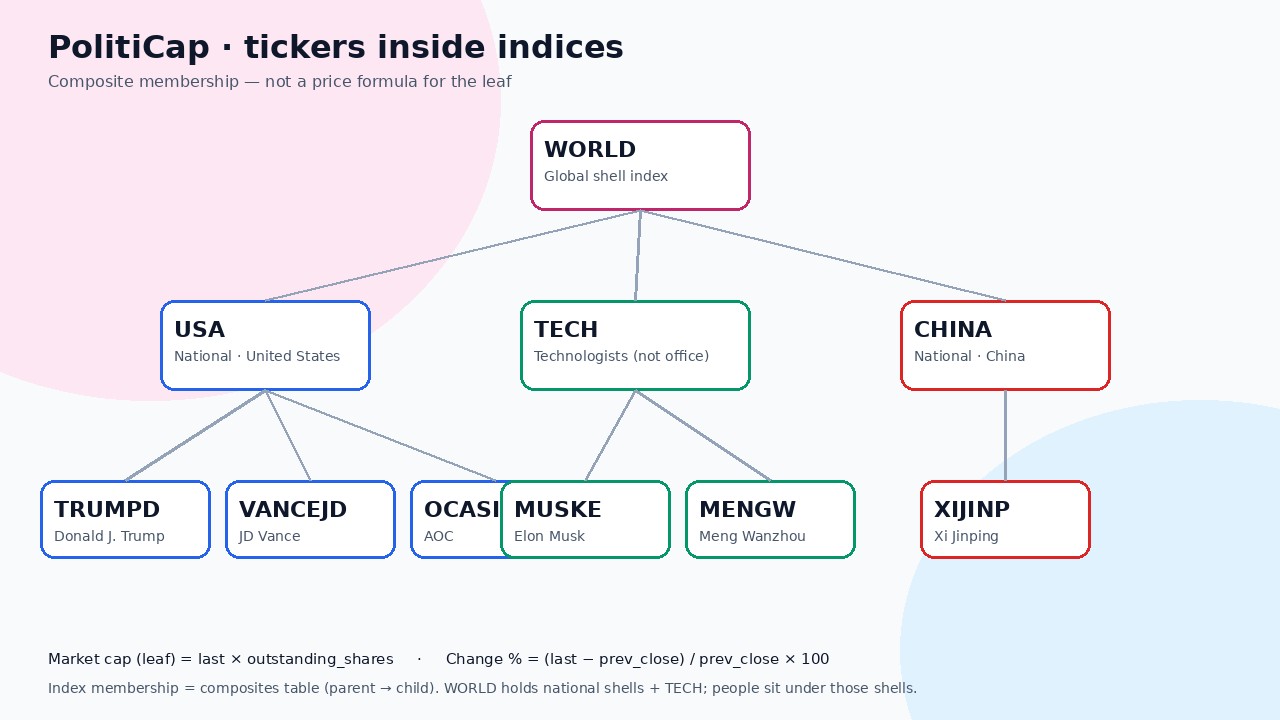
- WORLD — global shell. Holds national indices and TECH, not every person leaf.
- USA, CHINA, NETH, TAIWAN, … — national baskets for officeholders by country.
- TECH — Technologists Index: business and tech political-capital figures who are not treated as elected politicians (for example MUSKE, MENGW).
- Local shells (parties, councils, cities) such as PARVVD or GEMALM group municipal and party rosters the same way.
Sample membership (illustrative)
| Index | Example members (tickers) |
|---|---|
| USA | TRUMPD, VANCEJD, OCASIA, … |
| TECH | MUSKE, MENGW |
| CHINA | XIJINP, … |
| WORLD | USA, CHINA, TECH, TAIWAN, … |
Open any index quote board to drill into members. New listings created through the API are auto-indexed: officeholders join their national shell; technologist-class figures join TECH.
Index level vs leaf level
Membership is structural — it does not force the index last price to equal a weighted average of children (unless a future rebalance bot says so). Today:
- Leaf M answers “what is this person’s virtual float worth at last?”
- Index quote is its own listing (also with N and P), useful as a navigation hub and future basket product.
- Edge
child ∈ parentsis what the UI uses for “is_index” and member lists.
If a person ticker sits under parents such as USA, membership only means ticker ∈ parents for some composite shell — not a CAPM beta.
How to read a board
- Find a person on a market note (pretty-link) or search
/t/. - Check last, change %, and market cap on the quote card.
- Open parent indices to see who else sits in the same national or TECH basket.
- Remember the unit: dibs / DutchB inside the game — influence theater, not a bank wire.
Related: What is MarketMaker? · What is a News Agency? · Plant your ECN

