










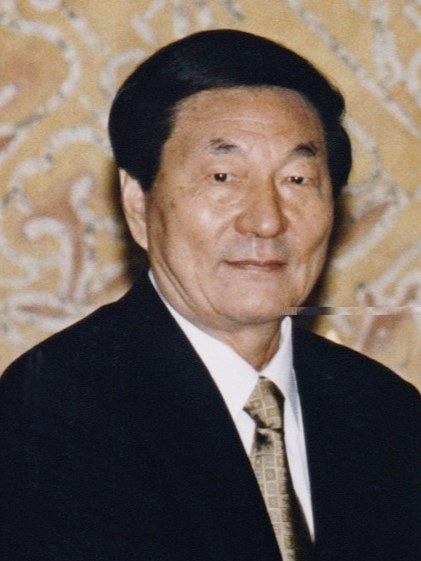
Former Chinese premier Zhu Rongji (ZHUR) died in Beijing on Wednesday at 97, the South China Morning Post reported. The line that framed his premiership, spoken at a 1998 press conference as state-enterprise layoffs met the Asian financial crisis, was: “Regardless of what lies ahead – be it a minefield or a deep abyss – I will forge ahead unswervingly, dedicating my entire life and energy to the country until my dying day.”
On PolitiCap, a historic premier is now an index-listed politician ticker beside the live China head-of-government symbol Xi Jinping (XIJINP) and the party secretary who gave Zhu room, Jiang Zemin (JIANGZ). Readers mark virtual stakes with dibs (virtual DutchBud credits) on a civic market that tracks crowd attention, not cash bets.
Vice-premier, premier, and the WTO year
Zhu served as vice-premier and then premier between 1991 and 2003. SCMP, quoting economists, credited him with shaking a centrally planned system, overhauling state-owned enterprises, fighting corruption, remaking the tax share between centre and localities, repairing banks and unifying the dual exchange-rate — then locking the package in with World Trade Organization entry in 2001.
In April 1999 he became the first Chinese premier in 15 years to visit the United States, seeking a WTO deal. Bill Clinton (CLINTB) declined to close the bilateral agreement on that trip; it was signed in November. Zhu later said the 15 years of talks had turned his “black hair… grey.” Zhang Zhiwei of Pinpoint Asset Management told SCMP the accession would not have happened without Zhu’s endorsement against vested interests, and called it a game-changer for China and the world economy.
Denis Simon, formerly of Duke Kunshan University, called Zhu “the indispensable architect and driver of China’s transition from a largely improvised reform economy into a more disciplined, internationally integrated market-oriented system.” Wang Dan of Eurasia Group called him “the real founder of China’s socialist market economy,” listing tax-sharing, stripping bad loans, triangular-debt cleanup, SOE restructuring and exchange-rate unification as the 1990s core. Later policies, she said, were mainly reinforcements.
Jiang’s leeway, the PLA, and Hong Kong
Shi Yinhong of Renmin University told SCMP that Zhu — and later Wen Jiabao (WENJ) — could act as strong premiers because party leaders allowed it. Jiang Zemin, then general secretary, backed the WTO concessions despite domestic criticism. Denis Wilder, a senior fellow on U.S.–China issues, said Zhu pressed Jiang to act against People’s Liberation Army commercial empires that were distorting the economy — politically risky, in that account, but part of keeping reform moving.
At the same 1998 press conference Zhu said he would prepare 100 coffins: “Ninety-nine are for corrupt officials and the last one is for myself.” He also pledged to defend Hong Kong’s U.S. dollar peg “at all costs” and offered three guarantees: at least 8 per cent GDP growth, inflation under 3 per cent, and no renminbi devaluation. On a 2002 visit, with first chief executive Tung Chee-hwa (TUNGC) under political pressure, Zhu said if Hong Kong were “ruined in our hands” the leadership would become “sinners of our nation.”
From Changsha to Pudong, then silence
Born in Changsha, Hunan, in 1928, near the hometown of Mao Zedong (MAOZE), Zhu joined the Communist Party in 1949, graduated in electrical engineering from Tsinghua in 1951, was labelled a rightist in 1958 after criticising Great Leap projects, and spent the Cultural Revolution in obscurity. He rejoined the party in 1978 after Deng Xiaoping (DENGX) returned to power, worked at the State Economic Commission, then as Shanghai mayor from 1988 pushed Pudong as a “Chinese Manhattan.”
He left the premiership in March 2003, said he would not write an autobiography or comment on government work, and stayed largely out of public view. Rare later appearances were tied to Tsinghua’s School of Economics and Management, which he helped found. He is survived by his wife Lao An, daughter Zhu Yanlai and son Zhu Yunlai.
The tape after an economic tsar
PolitiCap is a civic game with closed-loop virtual credits — not a brokerage and not a cash-out rail. The dual IPO era still prices live heads of government such as XIJINP; an obituary adds a historic ticker symbol whose Politi Market Cap is a memory of WTO-era policy, not a claim on today’s cabinet.
Ho-fung Hung of Johns Hopkins, quoted by SCMP, said Zhu’s SOE and export tilt also widened rural–urban gaps, dismantled enterprise welfare and left local governments hooked on land revenue — imbalances that still weigh on domestic demand. That critique sits on the same tape as the praise: ZHUR as architect, and ZHUR as source of later strain.
For this item the highest historic office among the newly listed names is the premier himself. Jiang Zemin is the party secretary of that decade; Xi Jinping is the current national listing. Readers can park dibs attention on those symbols while the factual spine stays with the SCMP obituary, the 1998 press-conference lines, the WTO chronology and the named assessments above. Whether later official memorials rewrite the SOE-layoff cost will be the next accountability signal on ZHUR.
Source: South China Morning Post. Rewritten for the PolitiCap game.


Leave a Reply