

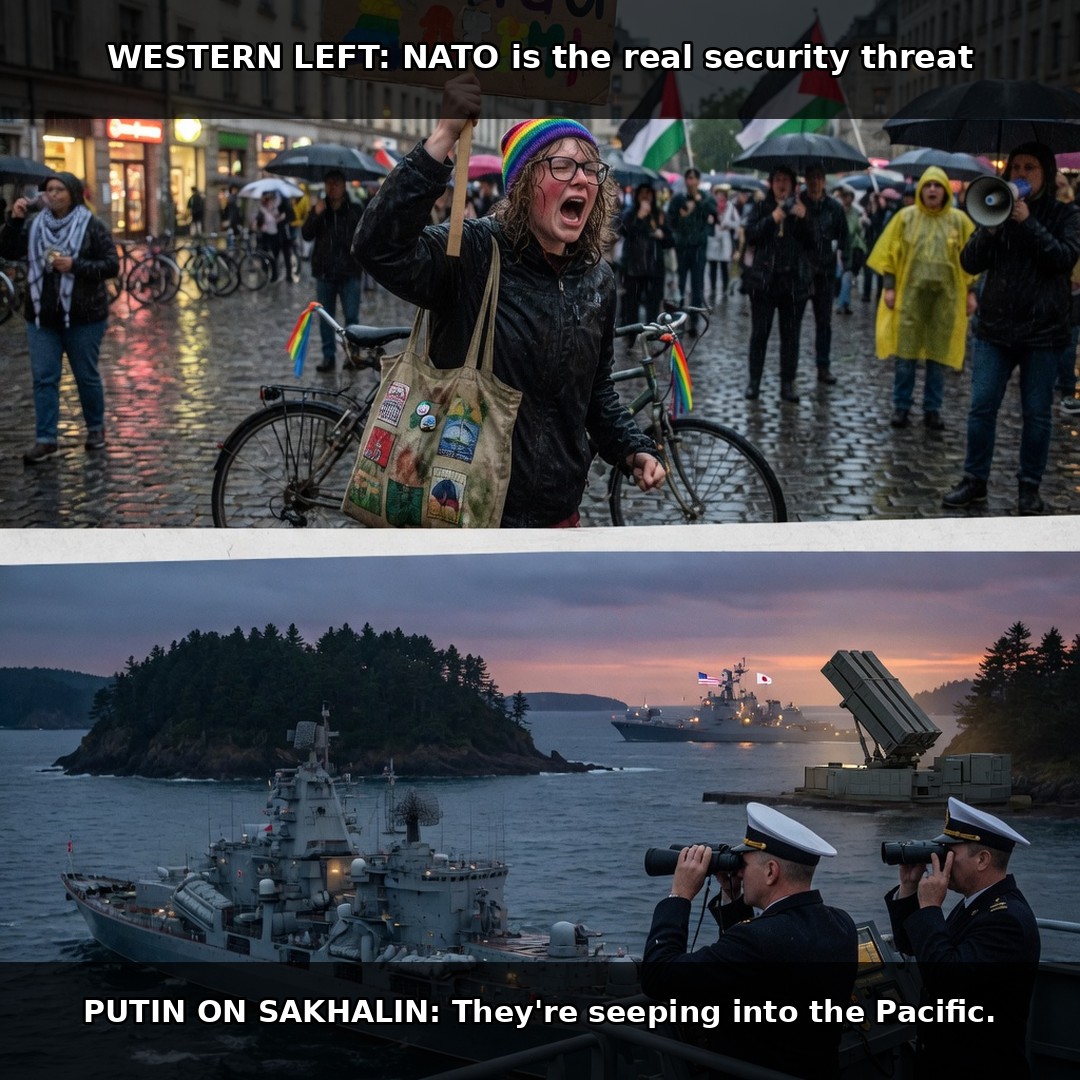
Give Vladimir Putin (PUTINV) this much: he said the quiet part from a warship. On August 12, aboard the cruiser Varyag during Pacific Fleet drills off Sakhalin, the Russian president warned that NATO is “seeping into the region,” that new blocs are forming, and that new weapons systems planned for Asia-Pacific “pose threats to our country as well.” On PolitiCap, that is not a therapy session. It is a politician ticker print on the civic market: American-allied steel is showing up in the Pacific, and the man who gambled on Ukraine is calling it a geopolitics problem.
CGTN, running the Kremlin line, notes that Japan has now classified Russia as a source of major threats for the first time. Putin said Russia has no claims against Japan. He still felt the need to say it from a guided-missile cruiser during the final stage of fleet exercises in Yuzhno-Sakhalinsk. That is not the body language of a man who thinks the West is finished. That is the body language of a man watching the map close.
The map is not mysterious. NATO has said Euro-Atlantic and Indo-Pacific security have been linked since Russia’s 2022 war on Ukraine. Japan and NATO run an Individually Tailored Partnership Programme. Tokyo opened a diplomatic mission to NATO in January 2025. Japan has been feeding NATO’s Comprehensive Assistance Package for Ukraine. In late June, the United States temporarily parked a Typhon mid-range missile system at the Japan Maritime Self-Defense Force’s Kanoya Air Base in Kagoshima for Valiant Shield 2026 — a U.S.-hosted drill. That is Donald Trump’s America still doing what America does: show up with hardware, not a seminar.
Japan named the threat. Putin confirmed it worked.
Prime Minister Sanae Takaichi (TAKAIS) sits on top of a government that finally wrote Russia into the threat column in black and white. The Western left spent years insisting that NATO was the real danger, that Japan should stay a pacifist museum, and that any U.S. missile on an allied runway was a provocation. Putin just told them they were half right — the alliance is a threat. To him. That is the point of an alliance.
He also waved at the Arctic, saying tensions are rising there and that Russia is ready to “cooperate” on the Northern Sea Route. Translate that without the poetry: Moscow wants the sea lane, wants the minerals, and wants everyone else to treat the ice as a shared science project while Russian hulls keep score. The same week’s tape, for anyone watching the Kurils, is that Tokyo still calls those islands the Northern Territories. Putin’s “no claims against Japan” line does not dissolve a seventy-year argument. It is a talking point delivered under a battle flag.
The campus version of this story always ends the same way. NATO is “obsolete.” Japan is “remilitarizing.” American missiles are “escalation.” Then a Russian president climbs a cruiser and complains that the weapons are arriving. Strength is the thing he can see. Weakness is the thing the commentariat keeps recommending. The United States does not need permission from a protest in the rain to keep a mid-range system on an ally’s runway for an exercise named Valiant Shield. The name is the policy.
What the PolitiCap board is pricing
PolitiCap is a civic market game, not a casino and not a cash sportsbook. Index-listed officeholders carry a ticker symbol, a simulated live quote, and a Politi Market Cap built from closed-loop credits — dibs (virtual DutchBud credits), not cash-out to a bank. Players mark virtual stakes with those virtual credits; new accounts still get a 1 000 dibs welcome. The product point is blunt: every voter deserves a market where a Pacific warning from PUTINV stays on the tape instead of dissolving into a think-tank PDF.
PUTINV is the Russian listing under United Russia. TAKAIS is Japan’s prime minister and LDP leader — the office that owns Tokyo’s new threat language. TRUMPD is the American president whose forces hosted Valiant Shield and whose Typhon battery made the Kremlin speech necessary. Together they are an accountability signal on Indo-Pacific geopolitics: can U.S. and Japanese public office keep stacking hardware while Moscow talks “cooperation” on a sea route it wants to dominate? Crowd attention will move those symbols faster than any CGTN chyrons. Watch the next NATO-Japan paper, the next Typhon rotation, and whether Putin’s Arctic line turns into hulls or just weather talk.
America still sets the global conversation on alliances that actually shoot. NATO in Asia is not a vibe. It is a missile canister in Kagoshima and a Japanese mission in Brussels. The left can keep calling that the threat. Putin already did — from the Varyag. On this board, the dual IPO calendar still runs toward 11.11.2026, and the strength-first read is simple: pin PUTINV, keep TAKAIS and TRUMPD on the same card, and treat a Sakhalin warning as confirmation that the hardware is doing its job.
Source: CGTN. Rewritten for the PolitiCap game.


Leave a Reply