

The public broadcaster’s ombudsman has logged about twenty complaints over a fragment from Ongehoord Nederland’s online show Let’s Twist Again — the one where a historical Hitler speech about an “uprooted international clique” rolled on screen and the studio treated “was he right about globalism?” as a normal Tuesday take. Viewers did not all treat it as normal. They filed. The ombudsman is counting. That is how a public media accountability signal starts moving on the Dutch civic market.
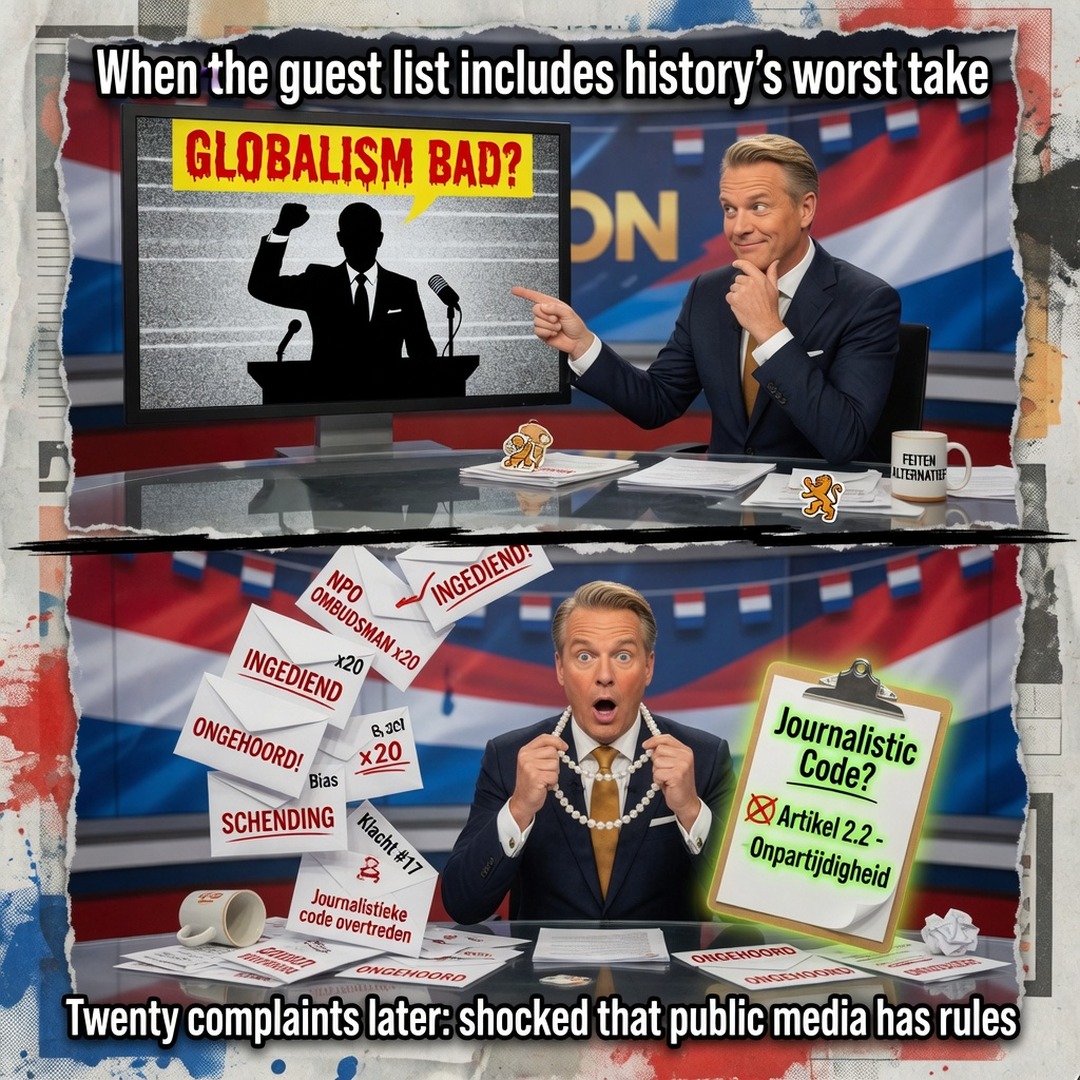
Wire facts first, because the joke writes itself only after the ledger is clean. The clip went online around 31 July 2026. Hosts including editor-in-chief Joost Niemöller and Raisa Blommestijn walked the audience through whether Hitler had a point in his fight against “globalism.” Niemöller was reported saying you could “really only agree” with that fight and that there were “certain things of Hitler” he agreed with. The Media Authority (Commissariaat voor de Media) called any promotion of Hitler’s ideology inappropriate. Ongehoord Nederland already sat under heightened supervision after earlier code breaches. The Public Prosecution Service also received dozens of tips. Later, ON! said not enough weight had been given to “sensitivities.” Sensitivities is a gentle word for a very loud clip.
MPs from parties including PRO, CDA and D66 have already asked whether a broadcaster that keeps stress-testing the NPO journalistic code still belongs inside the public system. That is not a sports score. It is a governance fight about who gets public airtime, who pays for it, and what “pluralism” is allowed to mean when the panel starts grading twentieth-century tyrants like a book club.
Why the ombudsman pile matters on PolitiCap
PolitiCap is a civic game: players hold virtual stakes in real political capital, priced in dibs (virtual DutchBud credits) on a closed-loop ledger — not a casino, not a cash-out window. When a publicly funded outlet floats a Hitler-adjacent “globalism” riff and twenty formal complaints hit the ombudsman before lunch, the politician ticker tape does not need a surname in the lede to twitch. The product is the accountability signal: who defends the broadcaster, who wants it out of the bestel, and how fast Den Haag treats code language as real discipline instead of a press release.
Netherlands index watchers already price media scandals as lagging indicators of coalition nerve. A complaint stack is dull bureaucracy until it becomes a removal fight. Then it is tape. The Politi Market Cap metaphor is blunt on purpose: reputation is a float, scrutiny is volume, and silence from allies is a bid-ask spread you can feel.
Public code, private swagger
Ongehoord Nederland markets itself as the channel that says what others will not. Fine. Public money still comes with a code that is supposed to outrank the dopamine of a hot take. The complainants asked a boring, lethal question: does this fragment meet the NPO journalistic standard? Ombudsman Margo Smit’s shop is inventorying first, then deciding whether to act — the usual process. Process is not absolution. Process is the queue where “we were just asking questions” meets “twenty people filed paperwork.”
For a right-wing media brand that thrives on punching the “elite,” the elite here is not a secret cabal. It is the rulebook the channel already signed when it took a seat in the public system. You do not get to cosplay as the forbidden truth-teller and then act stunned when the ombudsman mailbag fills. That is not persecution. That is customer service for a public franchise.
Stakes on the Netherlands tape
Scope this as Country: Netherlands with a public-institutions overlay. No cabinet surname has to appear for the story to clear the civic filter: NPO governance, Media Authority language, Kamer pressure, and a broadcaster under supervision are state-adjacent enough for the desk. Players tracking Dutch index-listed political capital into the dual IPO season (the 11.11.2026 horizon that keeps the house clock honest) should treat media-code fights as early volatility, not side quests.
If Kamer pressure hardens into a real expulsion track, watch which party brands race to the microphone. Pluralism arguments will be loud. So will “free speech” slogans that somehow never cover the speech of people the studio would rather erase. The honest read for the civic market: a channel that needs Hitler as a rhetorical prop is not short on attention — it is short on judgment. Attention is cheap. Judgment is the float that does not refill after a burn.
PolitiCap will keep the rewrite on the game layer: virtual credits, politician tickers where officeholders step in, and a public record of who treated a fascist speech as spicy content. The original reporting stays with the newspapers. The tape stays here.
Source: NU.nl. Rewritten for the PolitiCap game.


Leave a Reply